
What 10 Minutes of Downtime Revealed About Critical System Data in Modern Operations

When people hear a story about manufacturing downtime, they usually focus on the obvious lesson:
Downtime is expensive.
They’re right.
But I think they’re also missing a key point.
When a European chocolate manufacturer operating a highly automated production facility experienced a production line stop lasting ten minutes, a chain reaction followed. Like many modern operations, every process depended on a complex network of software, automation, and production systems working together seamlessly.
As a result, what followed wasn’t just a production delay.
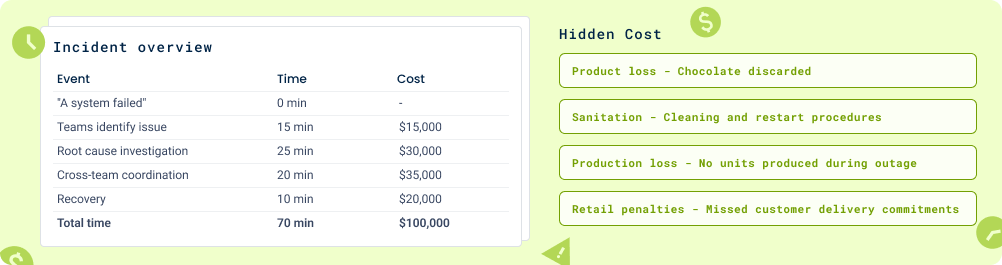
Chocolate already in production had to be discarded.
Equipment required a complete sanitation cycle.
Production schedules slipped.
Customer deliveries were delayed.
Labor costs climbed as employees worked overtime to recover.
By the time the operation returned to normal, the incident had cost well over $100,000. On paper, it looked like a downtime problem. But the real story was everything the operation couldn’t see.
Small Events Rarely Stay Small
Manufacturing leaders often think about failures as isolated events.
A robot stops.
A conveyor faults.
A WMS transaction hangs.
A PLC loses communication.
Those events are certainly important. But modern manufacturing operations are incredibly interconnected. When one part of that environment changes, the business is impacted by the ripple effects that follow.
As the chocolate manufacturer saw firsthand, what starts as a ten-minute interruption can quickly become an enterprise-wide event. Even more than simply recovering from the interruption, the real challenge is understanding the interruption while it’s unfolding.
Every System Knows What It Did
Here’s the problem I see in many operations today: every technology understands its own role.
The warehouse management system knows where inventory should be.
Automation controllers know how equipment is performing.
The ERP knows what orders have been processed.
The network team knows whether devices are communicating.
Every system is telling their truth, but virtually none of them understand the operation.
That distinction matters.
Because when something unexpected happens, organizations aren’t just solving the problem. They’re first trying to understand what the problem actually is.
Teams jump between dashboards and compare logs. Different departments investigate disconnected applications. Everyone sees a piece of the puzzle, but no one sees the entire picture. Business impact continues to grow.
The chocolate manufacturer didn’t lose $100,000 because a production line stopped; the loss came from everything that happened afterward.
The inability to quickly and holistically understand the disruption allowed a ten-minute event to become an hour-long operational recovery.
Operational Understanding Is Now a Competitive Advantage

It’s not uncommon for manufacturers to spend hundreds of thousands of dollars investing in better technologies. Better robots, warehouse software, automation, and better enterprise applications.
Today, these technologies generate more data than ever before. The problem is a lack of data context – transforming those millions of disconnected transactions into something people—and increasingly AI—can actually understand.
Because as operations become more automated, knowing how technologies interact is just as important as the technologies themselves.
Companies gain that understanding through context of the data they already have.
It’s knowing how one event influences everything else happening across the operation — and giving organizations the visibility to understand, respond, and adapt before those “soft errors” become enterprise-wide disruptions.
This is where the conversation shifts, and why operational visibility has become so important.
Organizations don’t need another disconnected application showing another isolated metric; they need a way to connect technologies, capture execution-level activity, and understand how their entire operation behaves in real time.
That’s exactly what the SOFTBOT® Platform was built to do.
Rather than treating automation, warehouse software, enterprise systems, and connected technologies as separate islands of information, the SOFTBOT Platform captures and contextualizes execution-level events across the entire environment.
The result is a resilient infrastructure that delivers a complete operational picture.
- Faster root-cause analysis
- Greater visibility across technologies
- Earlier recognition of performance trends
- Better optimization of technology investments
- More informed operational decisions
Organizations gain something that’s becoming increasingly invaluable: confidence in the data they’re using to make decisions
Together, it creates the trusted data foundation for enterprise and physical AI—because AI outcomes are only as good as the operational truth underneath them.
The Bigger Lesson

The chocolate manufacturer’s story isn’t really about chocolate. And it isn’t really about downtime. It’s about the hidden cost of operational blind spots.
Every connected operation will experience disruptions; those events aren’t going away. So, the organizations that thrive in this next phase of industrial automation won’t be the ones that eliminate every issue — they’ll be the ones that understand the interdependencies faster than everyone else. They’ll have the clearest visibility into how their operations collectively behave; not just how individual technologies perform.
Because operational understanding improves every decision that follows. And as manufacturers give more consideration to how they will use AI to advance their business, that understanding becomes even more important. AI cannot understand an operation if the operation itself isn’t understood first.